Exploring Carbon Dioxide Storage for Alaska’s Railbelt Energy Future
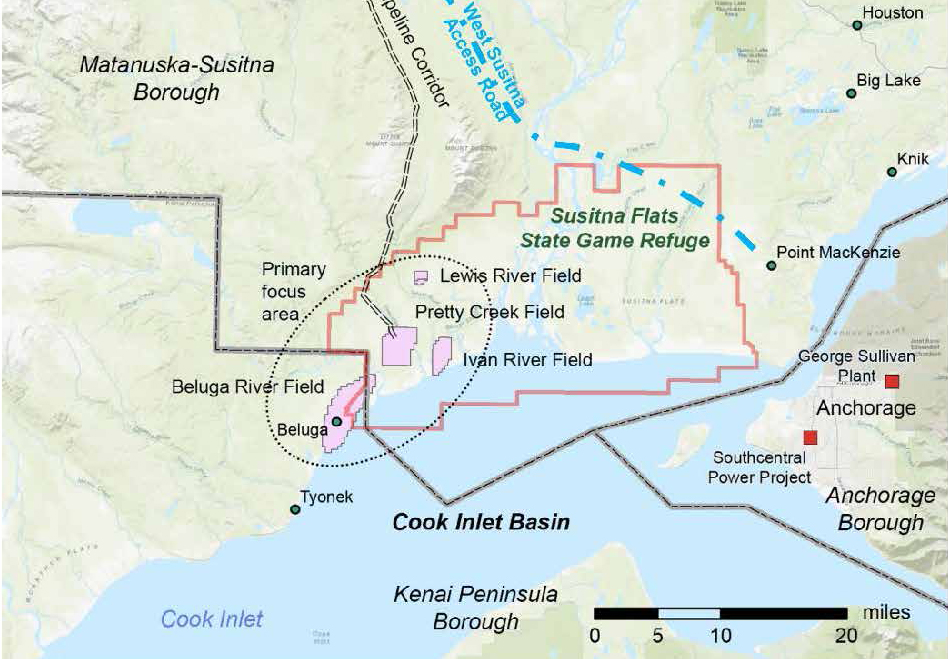
The Alaska Railbelt Carbon Capture and Storage (ARCCS) project is evaluating the technical feasibility of permanently storing carbon dioxide (CO2) deep underground along the northwestern shoreline of Cook Inlet. The primary target is a deep saline formation called the Tyonek Formation, which is a sandstone formation about 8000 feet deep that is overlain by thick formations of impermeable rock that would prevent CO2 from migrating vertically. While the storage target is not yet dedicated to any particular source of CO₂, the ARCCS project is evaluating CO2 pipeline transportation routes to this location from a proposed new coal-fired power plant in West Susitna and from the two existing Chugach Electric Association natural gas power plants in Anchorage. Both the geologic and pipeline evaluations are currently at the feasibility stage, and no plans for permitting or construction have started, thus putting any actual commercial development timelines months or years away.
A CO₂ storage site and subsequent development of a commercial-scale project in the northwestern Cook Inlet could unlock:
Economic value
Energy stability
Environmental stewardship
STEM inspiration
A CO2 storage site in northwestern Cook Inlet could facilitate development of a proposed coal power plant built with CO2 capture technology. If built, a coal-based plant would reduce the Railbelt’s energy (electricity) challenges by using abundant local coal supplies as the fuel source. With more than 100 years of coal reserves, this plant would help stabilize electricity costs and ensure reliability and security of Alaska’s Railbelt (from Homer to Fairbanks) energy system. A new coal-based plant would reduce pressure on the region’s dwindling natural gas supplies and add stable energy to shore up the electric grid when the region needs power.
The ARCCS project is laying the groundwork for future CCS development by providing an understanding of the subsurface and identifying potential pipeline routes that minimize potential impacts in the project area. CCS in the northwestern Cook Inlet area will provide options for low-carbon energy development in the region for not only future projects, but existing facilities as well.
An ARCCS storage site would also provide options for carbon dioxide capture at other plants in Southcentral, including Chugach Electric Association’s natural gas power plants to reduce their carbon footprint. ARCCS also opens the possibility of capturing carbon dioxide from the six-coal fired powerplants in the Interior and transporting it by rail to Southcentral for storage in one managed facility, if a more local carbon dioxide storage site cannot be found.
What makes CCS development an important component of the local economy is that some businesses, cities, states, and governmental units—whether local, state, or federal—see low-carbon energy as a desirable trait, potentially keeping existing markets open to Alaska resources and products, with the possibility of attracting new industry development to the state, further enhancing Alaska’s economic development.
Visit our FAQ page to explore frequently asked questions.