Purpose
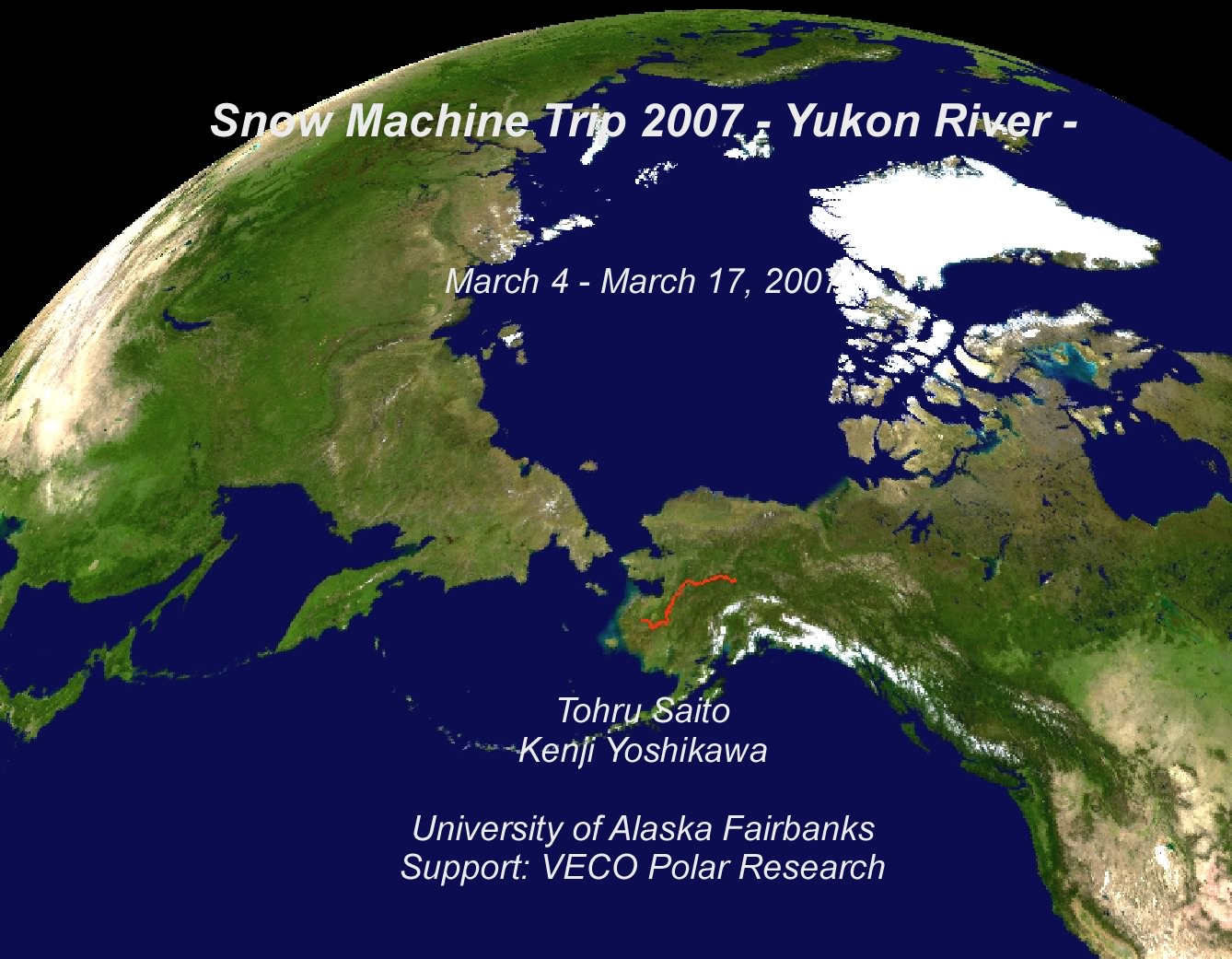
The University of Alaska EPSCoR program is conducting an outreach effort in
conjunction with it's research focus on permafrost and infrastructure. The
outreach effort has been termed the "Permafrost Health" program and
consists of installing permafrost temperature monitoring systems along the Yukon
River Villages by snow machine!
The
objective is to establish the long-term permafrost monitoring
sites at the adjacent of schools along the Yukon River between Tanana
(Manley Hot Spring) and St. Mary. Permafrost conditions will be a one of the
important indicators for the future climatic change. Permafrost strongly affects
local ecosystems, hydrological regimes and natural disasters. The design of the
long-term permafrost observation is fitting not only science objectives but also
involving remote Native Villages/Schools. Most of these villages depend on
a subsistence lifestyle and are directly affected by climatic and permafrost
warming. As the same time, there is colossal attentions and interest of the
northern native villages for people from none permafrost area.
Our proposed outreach project involves drilling boreholes at the village
schools and installing the micro data logger with temperature sensors to measure
air and permafrost temperatures hourly. The well trained teachers at the
schools are downloading data every other month and discussing the results with
students in the classroom. Obtained data is share with all of the arctic
countries and communities through the internet (http://www.uaf.edu/permafrost).
The teachers at the schools can demonstrate and compare the other villages’
data set. This is an important science project for these remote villages that
have limited exposure to science.
Schedule / route
March 4, 6:00am departure
Fairbanks VECO office
afternoon drilling at Manley Hot Springs
March 5 AM lecture at Gladys Dart School (Manley Hot
Springs)
PM move to Tanana and drill
with lecture at Maudry J Sommer School (Tanana)
March 6 AM move to Ruby
PM move to Ruby and drill
March 7 AM lecture at Merreline A. Kangas School (Ruby)
PM move to Galena and drill
March 8 AM
lecture at Galena high School
PM move to Koyukuk, lecture at Koyukuk
School
move to
Nulato, drill at Nulato
March 9 AM
lecture at Andrew K Demoski School (Nulato)
PM move to Kaltag, lecture at Kaltag School
March 10
move to Shageluk
March 11
drill at Shageluk
March 12 AM lecture at Innoko River School (Shageluk)
March 13 AM lecture at Holy Cross School
PM drill at Holy Cross airport
March 14 AM move to Russian Mission
PM drill and lecture at Russian
Mission School
March 15 AM move to Marshall
PM drill and lecture at Marshall
School
March 16 AM move to St. Mary
PM drill and lecture at St. Mary
Little School
March 18 Northern Air cargo shipping
Daily activity:
Packing the truck (3/3/2007)


We are loading (1200lb of drill equipments) the truck at VECO office.
VECO is an organization that supports NSF sponsored science projects.
Matt and Larry helped us prepare the snowmachines and other equipment.
Tomorrow we leave for Manley Hot Spring in a truck with two snowmachines
and a lot of drilling equipment.
Today's temperature was much warmer with temperature of -9F and light snow.
Excitement is growing, but we hear that the temperature is dropping in the
next few days.
Arriving at Manley Hot Springs (3/4/2007)


We left Fairbanks at 6:30 AM.
Along the way, we saw a lot of moose hanging out by the road. Luckily nothing
too close.
The road was good and it took us four hours to get to Manley Hot Springs.
Once we arrived, Heidi came to show us around the school and offerd us to stay
at the school. Thanks!
With out much delay we started working on drilling the first hole of this
trip.
As usual, it took much longer and a lot more complications than expected.
The cold temperture we are having also made it difficult.
The extremely cold layer of soil was freezing up the mud at the drill bit to
make it impossible to dig.
After a couple of hours struggle, we managed to get down to about 14ft.
But that also came with a price of the shaft being frozen in the hole.
After another hour of struggle we finally managed to break loose the shaft.
It was a good reminder. Be careful and don't be greedy when you're drilling.
It's olnly our first day of our field trip, but we are already feeling the
kindness of the community.
And many thanks to Matt Irinaga (VECO) for driving us out to Manley.
Manley Hot Springs to Tanana (3/5/2007)


After installing the thermister and data logger in the bore hole, Kenji talked
to the students at the Gladys Dart School (Manley Hot Springs). We spoke with
Gladys last night and received a personal welcome, we promised to provide a
unique experience for the students. After the talk we all visited the
permafrost station in the chilly wind. They were all good tough Alaskan kids!
Soon after the talk, we frantically packed our sleds for our departure.
Although we simulated the actual pack over and over again prior to our trip,
it took much longer to actually pack all of our gear (mostly drilling
equipment).
By noon we hit the trail. Still strong wind from the north was blowing down
and across the river. Luckily the trail was well marked and packed down enough
that traveling was relatively smooth. But the wind was just constantly hitting
us from one direction or another. Kenji's sled had minor problems with the
hitch. The bolts holding the sled snapped and broke. The quick fix was to tie
the sled with a rope.
4:00PM we arrived safely at Tanana. It was a great relief to make it there
without other problems. Dorothy and other teachers welcomed our arrival.
Tomorrow should be a calmer day, according to the weather forecast. We shall
wait and see.
Due to limited access of the Internet we were not able to update yesterday.
From Tanana to Ruby (3/6/2007)


Another cold morning. Where is Spring?
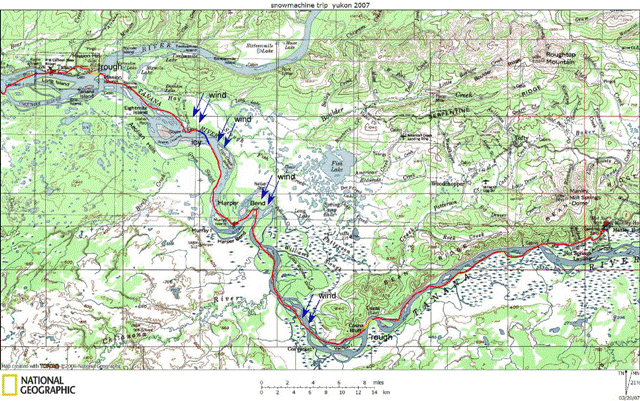
Today we took some core samples from the Yukon River and talked to the
students at Tanana. Although it was a rush thanks to Dorothy, she was able to
coordinate Kenji's talk with the high school students.
The biggest problem for today was getting the snow machines started. Last
night's temperature was well under -30F, and was still cold at 10 AM. These
two new snow machines without the pull cord can be a problem at times. We also
had to rearrange the sleds because of the hitch problem from yesterday.
By noon we were on the trail. Today we had to cover 120 miles of wind blown
trail. Even with the trail markers, it was difficult to navigate through the
drifted snow and blowing wind at times. Usually it may take about 4 hours,
since we had a lot of stuff, it took us more than 6 hours. But we were still
very happy to make it to Ruby, since we were also prepared to spend the night
on the trail somewhere if it got dark.
Ruby is located on a hillside and the school was located on top of the hill.
The heavy snow machines almost didn't make it up the hill to the school. The
principal, Bruce, was kind enough to open the locked doors for us to spend the
night, once inside the school Kenji is putting the ice core samples from
Tanana into vials.
Ruby to Galena (3/7/2007)


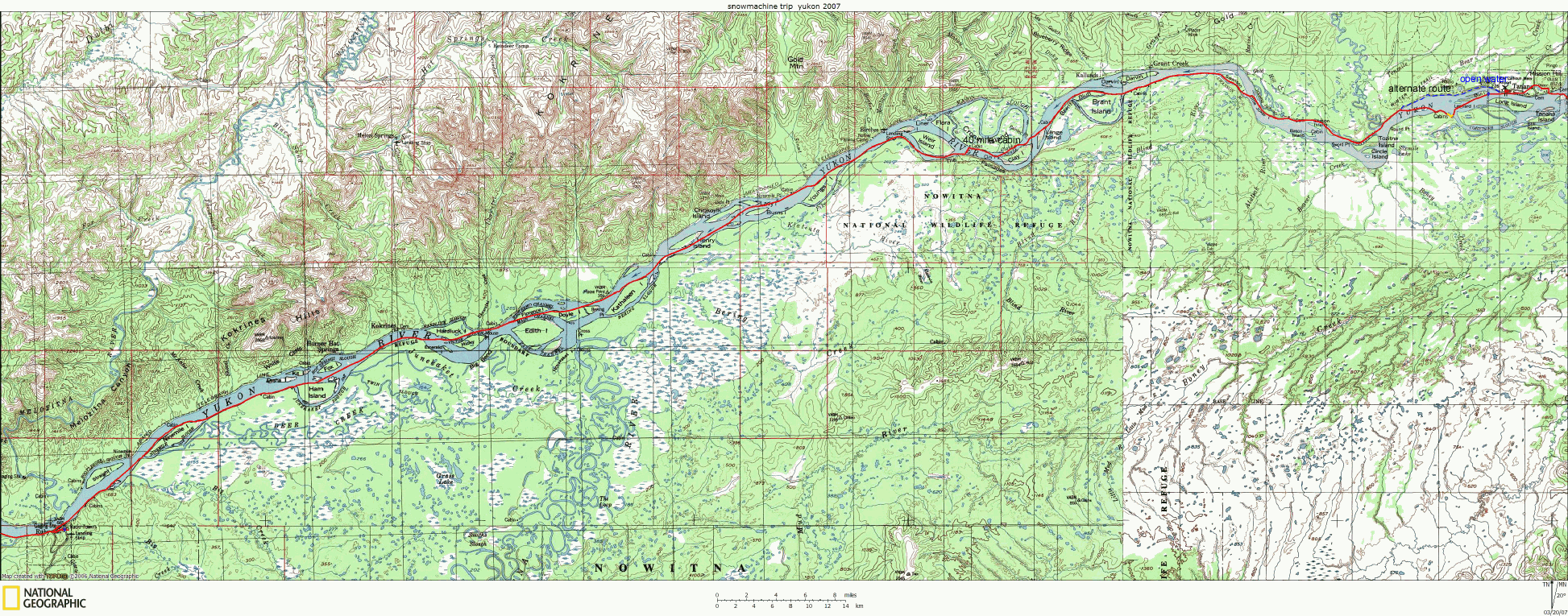
Kenji had a busy day at Ruby and Galena. He gave two talks in Ruby and then
talked to the students at Galena and drilled a permafrost monitoring station.
The temperature was -15 at Ruby. Considerably warmer than the past few days.
We were excited about the cahnge in temperature, but that soon changed. As
soon as we got down to the river the tempeerature was much colder and also
windy again. Does it ever stop blowing on the Yukon River?
May be due to the temperature or loose wire, one of the snow machine was not
running well. Sometimes it would just stop on it's own. It seemed to run okey
if we were going about 30 mph, but anything above that and it tends to have
problems. hummm...
The trail was well marked and packed down. On opening but it was heavily
marked like a porcupine. Along the way, Kenji took some water sample and core
sample from the river just before reaching Galena.
Galena has a huge runway because of the old military base. They just shut down
recently. THere are two schools here and one of them is called GILA. The
principal Harry and science teacher Shayne were great. They helped us with our
talk and the drilling. We started drilling after we talked to the kids, so by
the time we were done it was 9:30.
A good successful day.
from Galena to Koyukuk to Nulato and Kaltag (3/8/2007)
Today was a busy day meeting people.
Since Galena was a bigger town, we really wanted to try to fix the problem
with the hitch on the sled. Luckily the auto shop at the Galena Interior
Learning Academy was able to help us with it and the hitch is now securely
fastened. We broke four bolts so far and we only had two more spares, so this
fix was quite a relief.
We also got gas last night. 30 gallons of gas was about $150... These 4 stroke
machines get reasonable gas milage, and we are guessing about 10 miles per
gallon. They are also vbery smooth on the long straight away with lots of
power. I'm sure the packed down trail really helps too. The trail from Manley
to Kaltag was well marked and well travelled, probably something to do with
the Iron dog race.
Now, the battery situation with one of the machine is still a concern, but not
a major problem, especially since we aren't expecting anymore -40
temperatures. Maybe the battery is not charging correctly because of the
cold...? The one machine that kept on stopping for unknow reasons seemed to be
cased by a loose battery cable. After tightening the nut we didn't encounter
that problem today.

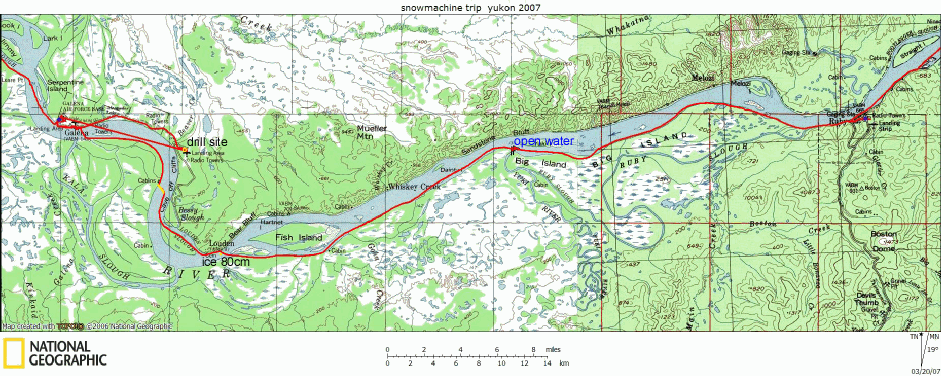
So, from Galena to Koyukuk was about a 2 hour ride, with snow and ice core
sampling along the way. Koyukuk is one of the smaller villages we are
visiting. When we got there the school was locked! As we were almost giving
up, the door opened and a guy came out. It was lunch time and the doors were
closed during lunch hours. What a relief! Josie was the principal and she is
originally from Koyukuk. Kenji talked to the older students about our trip and
permafrost for about 30 minutes, and we were on our way to Nulato.


After another 2 hours or so, we arrived in Nulato about 3PM. The Nulato school
is hosting the district basketball tournament for the next couple of days, and
some of the teachers we met from Tanana and Ruby were also there. Some kids
form those villages were also snowmiching there to watch the games. Here we
met principle Robert. We shook hands and promised that we will meet again.

One interesting thing about the schools we visited is that they all have
displays of old pictures of the village or art work from the local artists,
along with trophys.

Since Kaltag was only another 36 mile from Nulato, we decided to hit the trail
while we still had plenty of day light. By this time the temperature felt much
warmer, well it must be compared to -30, and it was mostly tail wind so it was
smooth riding to Kaltag. Kenji picked up one stranded snowmachiner 5 miles out
of Kaltag. As we arrived in Kaltag the sun was starting to set, and we quickly
found Principle Mike Day. He welcomed us into the school.

It is nice to actually meet the people we were communicating with by E-mail or
telephone, and to be able to put the faces together with their voice or
messages. Without all of their support our trip is impossible, and we thank
all of them for their help. We are also meeting many more people than we
originally contacted on this trip, and that's a bonus.
Tomorrow, we will try to drill a permafrost station here and maybe stay one
more night. Since it is the weekend coming up, schools will be closed and we
also need to find out about the trail condition a little more before we make
the longest stretch of travelling.

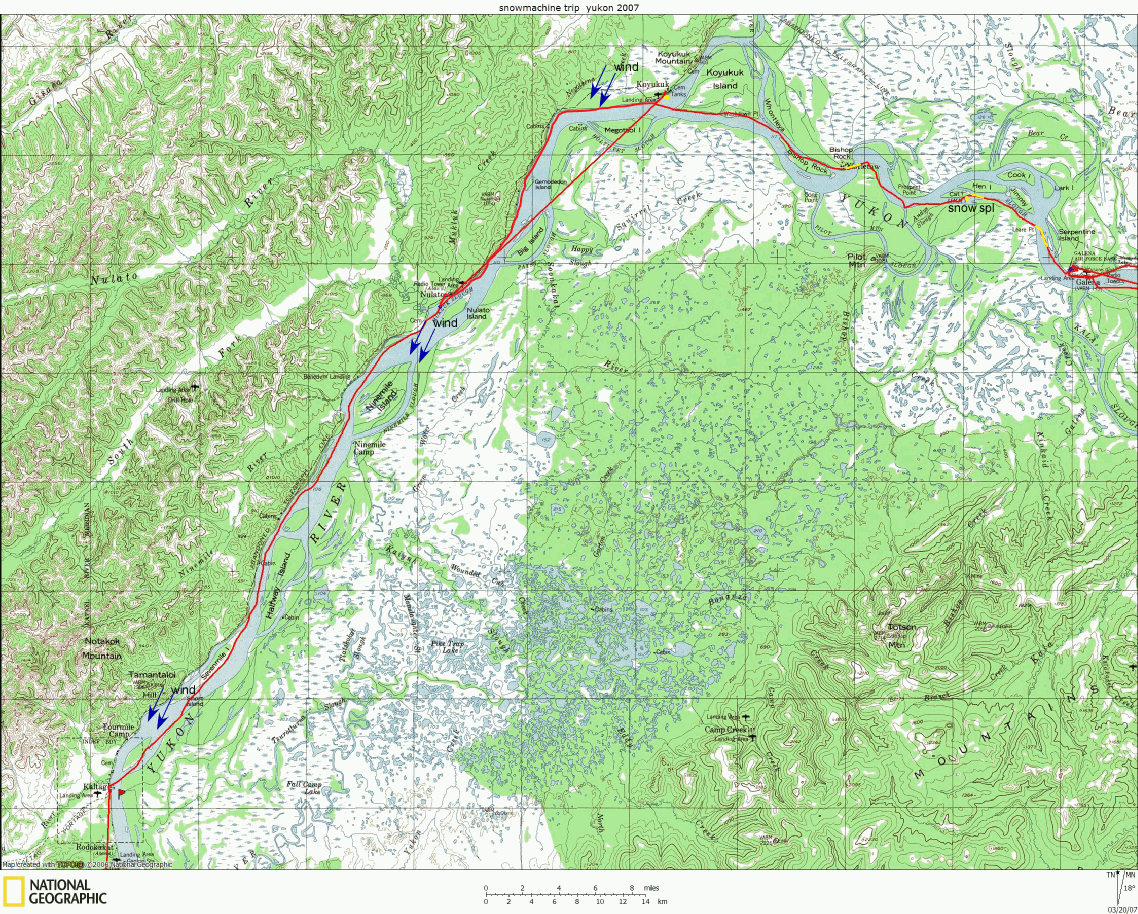
Drilling in Kaltag (3/9/2007)

Principal Day cooked biscuits and gravy for the teachers, and fed us too. He
said he was actually cooked for tomorrow, when the Iditarod mushers come
through Kaltag. It's not relly for the mushers, but for the follwers, news,
tourists that are travelling with the race. There were actually a lot more
planes landing here today, and a couple of new groups arrived at the school
today. The lead musher made it to Anvik around noon, a day away from Kaltag.
Today, our main goal for today was to install a monitoring station in Kaltag.
Yesterday we asked people about the soil type and chose a patch of wooded area
behind the school for the drill site. Conditions were in our favor accordint
to what we learned from the locals.

Today was another windy day. Temperature much warmer, maybe even above 0F, and
no wind in the trees.
Kenji started out with the portable drill set up, because of the dense trees.
If we're lucky we would only need the generator the electrical hammer drill,
and the stainless steel shafts. If this works, this is the ideal way to drill.

The first meter or so is usually easy, what happens after that is what really
makes a difference. The first few inches was organic material, soon it became
silt. Silt is relatively safe, but sometimes the silt can get sticky and suck
the shaft in and glue it to the ground. Kenji said it was one of those sticky
kind today. He was pulling on the auger so it wouldn't dig its self into the
ground and get stuck.

Luckily, there were no gravel all the way down to 5 meters, but Kenji had to
pay a lot of attention to cleaning out the hole so the shaft wouldn't get
stuck. The pin on the shaft also had a problem, so adding an extension took a
lot more effort than it usually does.

Once the hole was 5 meters deep, we carfully slid the PVC pipe into the bore
hole. Once this is done it's great relief. The borehole is secured!

Now the thermister and data logger must be place in the hole, but first we go
in the building to warm up.
When it's cold, threading the thermister cables through the PVC can be a
challenge, but it is a good feeling when you have another monitoring station
ready to go.

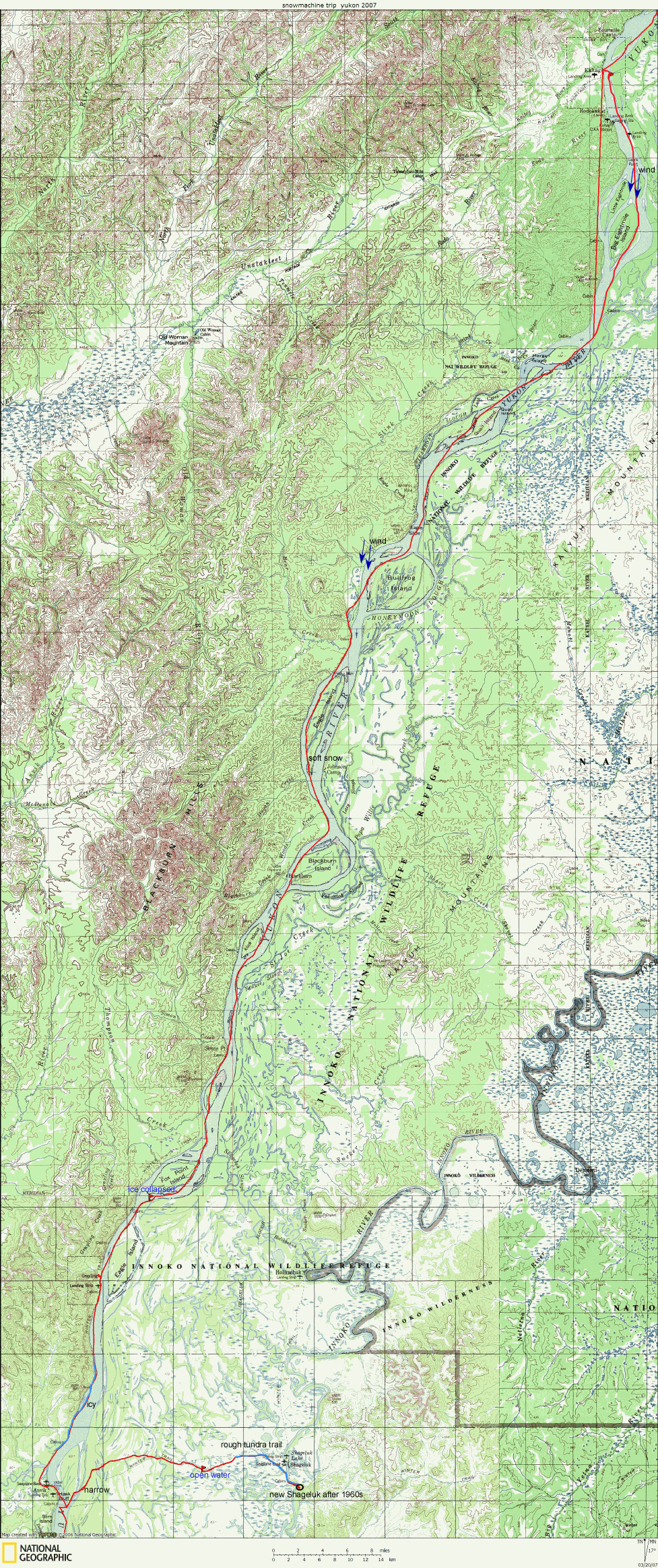
Kaltag to Shageluk (passing Grayling and Anvik) (3/10/2007)

Today was a big travelling day, both for us and the Iditarod mushers. We were
heading down and they were coming up river from Anvik. Since we had to travel
160 miles, we were anxious to hit the trail before noon. But first we waited
for the gas station to open up.


Meanwhile Kaltag was getting busier with people and activities. The early
arrivals were stting up their make shift sleeping areas in the school gym and
foreign reporters were out on the streets filming and intervieweing people.
After we said good by to Mike and Jake at the school, we were on th trail by
11:00.


We came accross the current leader, Jeff King, right at Eagle Island, which is
a check point for the race. It was 50 miles out of Kaltag in the middle of no
where, but a good place to take a break and out of the wind for the mushers.
The second musher, Martin Buser, was right behind Jeff King coming out of
Eagle Island.


Although there were some winds, and we passed through a brief white out of
blowing snow, it didn't feel as bad as it was just a couple of days ago. But
that was only because it was a strong tail wind. All the mushers facing the
wind looked like they were really having a tough time. I guess the dogs had it
the roughest, now that I think about it. The wind was slowing them down and
the ice crystals were hitting them in the face as they were mushing on.


Most of the musher were waving or asking how far it was to Eagle Island, but
for others the wind seemed to be too much to even lift their heads. One after
another, every half an hour or so, we saw another musher pass by.
Couple of hours later around 3:00 we arrived in Grayling. This was another
check station and maybe a few mushers were resting there. We just got gas and
hurried our way down the river. It would be best to reach Shageluk before
dark, especially going through wooded areas.

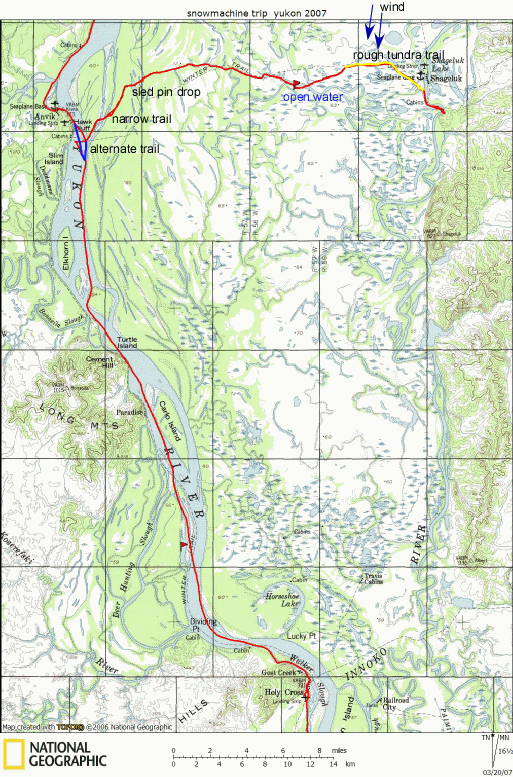
Anvik was only an hour away from Grayling. The trail to Shageluk braches off
from the Yukon River to a narrower on-land trail. Although this section was
not that long, it was probably the most intense and tireing section of this
trip, with very tight corners with bumps and most of all, very narrow. We came
accross one snow machine with a load of fire wood, and it was lucky that we
were able to pass each other. Another lucky thing was that we didn't see any
mushers along this part of the trail. That could have been a near disaster as
well.
As we got closer to Shageluk the trail was going through tusuks, and probably
because of the low snow this year, it was very hard packed and bumpy, so hard
that it was basically ice.

Around 6:30 we drove into Shageluk. The village was busy with allm the mushers
coming in and resting, may be about 10 teams.
We are a little wore out from the trip, and now we rest. Tomorrow we plat to
drill here.


Drilling in Shageluk (3/11/2007)

What a surprise!
No wind and above zero temperature.
This is what we and everyone along the Yukon River was waiting for, Spring!!!
Since today is Sunday, we had a slow start. First we met Joy, and talked about
the project and where we might be able to drill the hole. During that talk we
were told that some cold or flu is going around town and most of her students
were out last week.
On a trip like this, it's important to stay healthy so we took some extra
vitamins and a lot of water. The water here has a lot of mineral in it and it
smells a bit funny, also a yellowish color to it.

Our breakfast was the usual microwaveable "hotpocket" type things.
Soon after eating, Kenji was anxious to start drilling and he carries the
generator out to start it. Broken!!! One of our lifeline for the field work
doesn't work. So, Kenji works on it and finds a bunch of snow packed in the
inside of the generator. While the generator was being dried in the building,
we used electricity from the building to power the drill. The electrical cord
ran about 50 feet into the woods.


Although he hit tree roots and stuff, the bore holw was dug out in a couple of
hours, and the PVC successfully installed in the hole. Justin was there to
take pictures to show the other kids what we were doing.
Everything seemed to work a little easier with milder temperature and less
wind.


While we were doing this, more mushers were coming and going. Actually, one
left and two came in. The mushers arriving usually seems tired, and the dogs
also. But when they comes time to hit the trail again, the dogs are excited to
go, and just to be sure, the vets are there to check up on the dogs at each
check station.

We also installed the thermister and data logger inside the plastic casing to
take some readings, so Kenji can show it to the students tomorrow.
After that it was reorganizing the sleds and taking a look around Shageluk.
The sleds needed to be packed very good for tomorrow's trail condition. It
will be bumpy and a lot of tight ups and downs through the trees before we get
back on the Yukon River. Shageluk is located on the bank of the Innoko River.
As a matter of fact the school is called the Innoko River School. The current
village moved here in 1965 from the old site where it would always flood in
the Spring time. The airport is still located there.

After a brief break, Kenji went to the river to get some water sample and a
core sample. Core sampling Kenji style, which means using simple an light
weight equipment. This method is not recomended for the light weight.
Satisfied with todays work, we cooked dinner in the kitchen, and packed the
gear as much as we can for tomorrow.
Shageluk to Holy Cross (3/12/2007)

First Kenji talked to the students. He actually talked twice this morning.
Once to the middle school and then to the high school kids. There were far
less students in school than the total number of students. We heard that the
flu going around in the village and a lot of the school kids were out sick.
That explains why we didn't see kids playing outside over the weekend.


He talked in the gym for the mixed grades first. After a brief break, it was
round two with the high school students. After the talk we all went to the
monitoring station, and Kenji explained how the thermister and data logger
worked and showed the current ground temperature to the students.


Shageluk is involved in other science projects, and we hope ours will be an
addtion to their projects. After we thank and say good by to Joy, we rode out
of Shageluk.


The trail out of Shageluk was hard packed bumps for a few miles and then a few
miles of narrow trail that threads through the woods.


With all the bumps and turns, one of the sleds pin came out. Always carry
extra parts and pieces incase of emergency, and if you can, put the tool box
where it's easy to get to.

Once we hit the Yukon River, it was like a highway. The smooth hard packed
snow coverd most of the river. On top of the good trail condition, it was
sunny and warm.
Today was the first time we stopped for a while and had a little snack break.

By 3:30 we were in Holy Cross. The school was closed for a meeting in
Grayling, but Principal Kay made arrangements so that we can stay at the
school.
Holy Cross to Russian Mission (3/13/2007)

Holy Cross has a hill right behind the school.
From this hill you can see most of the village.


The school was clean and neatly organized.
We stayed in the library where we found a lot interesting Alaska related
books.
There were quite a few pictures and art placed in the school.


As we were leaving, principal Kay flew back from Grayling, so we were able to
meet her at the airport.
Thanks to John we had a good stay.


The trail from Holy Cross to Russian Mission was one of the least traveled
section on our trip. We saw some old tracks heading down the river but nothing
clearly marked the trail.


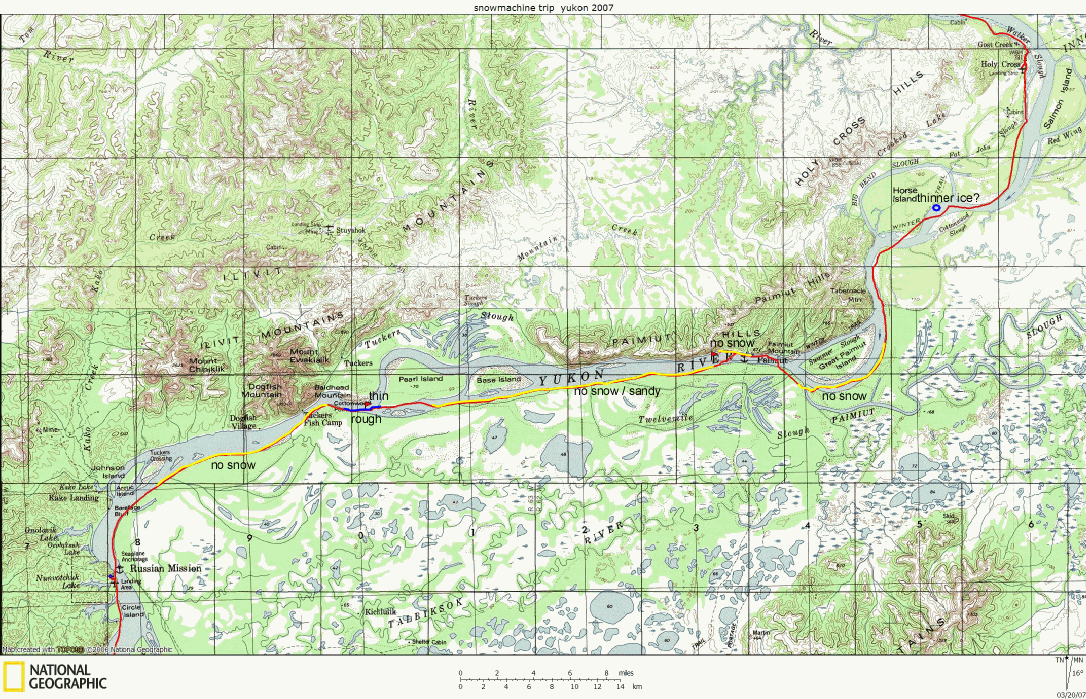
The reason was soon obvious to us. This stretch of the river was either ice or
sand, with very small patchy islands of snow the entire way. Our snow machines
were more like "sand machines" today.


Without clear markers, it was important to look around for directions, but it
was pretty much the same no matter where we went, icy, sandy and bumpy.


If it was ice, the back end of the sled would want to slide around. In some
areas the ice looked dangerously slippery and thin. Fresh ice and old signs of
overflow was here and there along the way.

Riding in sand is not that great either. It's like dragging the breaks as
you're riding and everything gets sandy. But Kenji likes the desert so I'm
sure he was having a good time...
We had hopes to reach Russian Mission in a 3 to 4 hours, judging from the
distance we were travelling up until today. But it took us more than 4 and a
half hours. We realized how well we had it on the Iditarod trail.

When we got into town we headed up the hill to the school, but the roads were
so ice that we couldn't make it up.
This whole area is lacking snow this year, and the roads are like polished so
slippery that you can slide down the hill with boots.


Once we parked our snow machines and sleds, we examined todays damage.
(Usually something lost or broken) We found that the case for the steel pipes
was broken, and also the Keel on the sled was completely bent.


Even after this long trip, Kenji successfully drilled another bore hole and
established another permafrost monitoring station.
Russian Mission to Marshal (3/14/2007)
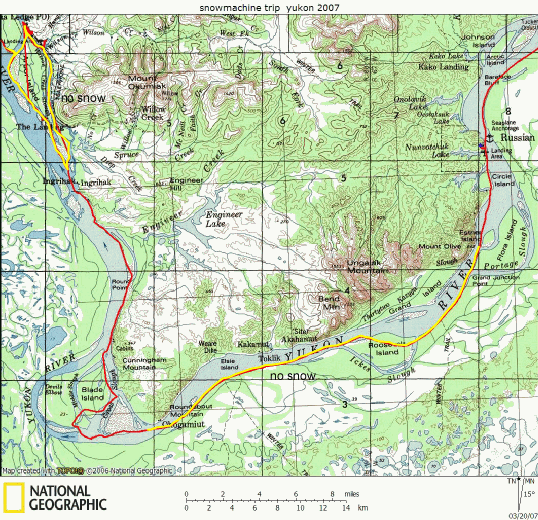
Another very rough day on the trail.


Russian Missioin sits on a hill side where it's protected from the wind. The
new side of the village is on the in the hills, and the older part of the
village is closer to the river.

Kenji talked to the upper grade kids at Russian Mission school. Principle
Jason was a great leader at the school and the students were very enthusiastic
about our visit. The whole class came out to take a quick picture as we were
leaving.


Thanks Jason Melanie (her mom) and Joe.


The trail condition was pretty much the same as it was yesterday, with fewer
signs of other snow machines. We were told that there's a trail, but we didn't
really see it... No trail markers, and occasional snow machine tracks that
disappear in the sand or the ice.
Just like it was yesterday, if it wasn't ice, it was sand. Even less snow than
yesterday with blowing sand this time... It's no wonder people don't travel
this way. But in the summer time there must be quite a bit more traffic. We
saw many fish camps along the river.


Although the trail conditions were crappy, the scenery was the best we had so
far. There were hills right up to the river with many colors of rocks. That's
probably why the ice is so bad around here.


As we got closer to Marshal the sand was blowing harder and hard to see where
you were going.
We saw one reamins of a fish trap left in the ice. Where there's open water
it's marked well. And theard that that everything froze up with this cold
weather.


Similar to what happened in Russian Mission, as we rode into the village we
got stuck as we were going up a hill. We were warned about the lack of snow,
but the road conditions were far worse than expected, with ice covering the
entire road. Some of the people watching us helped to get our stuff to the
school.


At the school Woody was waiting our arrival.
After we brought some of our gear in the school, Woody invited us over for
moose stew. On this trip, we've been eating mostly frozen microwaveable food,
so it was goot to eat real food.
Soon after supper, he showed us around where we might be able to drill.
At 8 PM, Kenji started drilling.
It was a preferable spot so we were hoping that it wouldn't be too difficult.
Even with above zero temperature, the wind chill factor made it feel much
colder. Hands were getting cold and equipments were not working right.
Despite the difficulties, by night fall Kenji had another monitoring bore
hole.
The thermister and data logger will go in tomorrow.


Marshal to Saint Mary's (3/15/2007)

Another two lecture day for Kenji. Just like it was in Russian Mission, there
were a lot of students in this school. It's good to know that they are working
on building a new school here. Marshal was windy with very icy roads. Moving
around in the village in snow machines pulling heavy sleds was a nightmare,
but the kids were having a great time playing and sliding on the slippery
roads.
People were very friendly, and many of the men, no matter where we go, were
curious about the big snow machines we were riding.
Thanks to Woody we found a good location for the bore hole. What was
interesting was that Woody met Kenji at UAF a few years ago, and then I also
met him while he was going to UAF almost ten years ago.


A little ways out of the village, we saw some Lute fish (burbot) traps, and
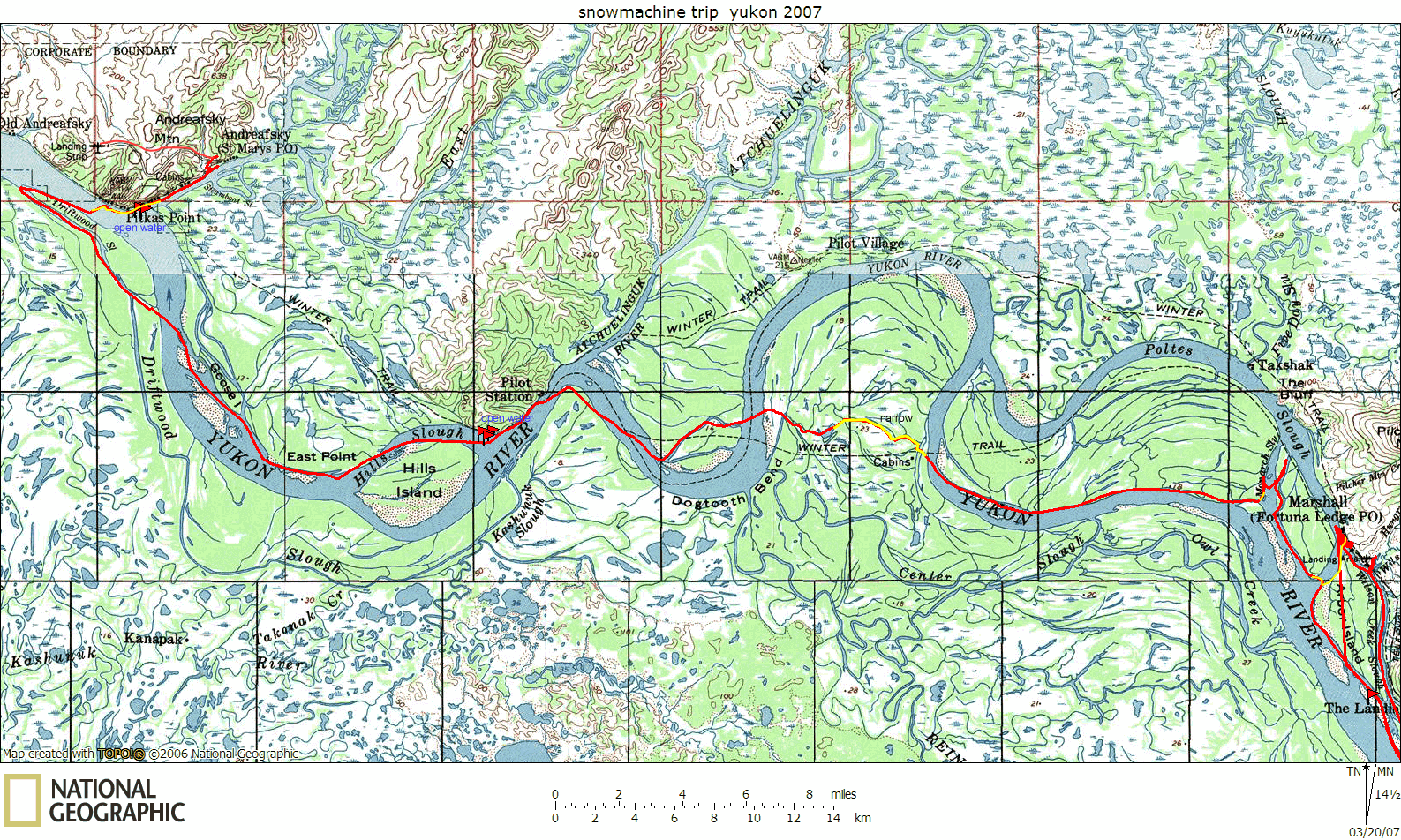
people digging them out. We heard that the trail from Marshal to Saint Mary's
is easy to find and good conditions with lots of snow. That was generally
true. But again, it took us much longer than expected. This part of the Yukon
River has many cracks with occasional thin ice, and the trail threads through
a lot of the sloughs and islands. When the trail crossed the section of river
with just ice, the trail disappeared into the clear ice.


After a few wrong turns and a couple of extra hours we made it to Saint
Mary's.
St. Mary's is one of the larger villages in this area. Like many other
villages the school was located on top of the hill, and we couldn't find our
way there without some help.

We met with Craig, the science teacher and Dave, the superintendent as soon as
we got there. It was a busy day at the school with teacher and parents
conference.
Dave invited us over for some Yukon King for dinner.
Saint Mary's drilling, lecture and the end of the trip (3/16/2007)


As of last night we didn't knwo if we could drill at Saint Mary's. With Dave's
help Kenji was able to secure a spot to drill.
The plan was to finish drilling before the lecture at 11:30, and then install
the thermister and data logger so we can take a reading before we leave here.

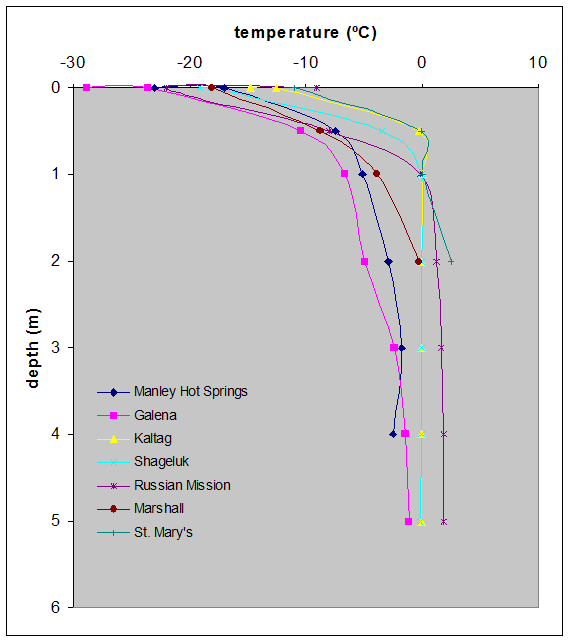
Permafrost drilling and profiles:
Snow machine gas mileages:
| Gas
filling |
qty (gal) |
price $/gal |
total ($) |
| FAI |
36.72 |
2.249 |
82.59 |
| Tanana |
12.12 |
5 |
60.61 |
| Galena |
27.75 |
5.25 |
145.70 |
| Kaltag |
12.10 |
5 |
60.50 |
| Grayling |
15.40 |
5.5 |
84.70 |
| Holy Cross |
15.09 |
5.5 |
83.00 |
|
|
|
|
| total |
119.19 |
|
517.10 |
| acutual usage |
158.19 |
|
|
The average gas mileages was 9.89 mile/gal. each machine.
pulling 1200lb equipments for both two machines
Snow machine/ equipments
Snow machine:
Skidoo expedition TUV 4 stroke 2007 model:
Engine:
2-TEC 600 H.O. SDI V-800
Color: Black
Platform:
Yeti
Front
Suspension: SUV trailing arm
Front
Shocks: Hydraulic
Rear
Suspension: SUV-Type
Rear Shocks:
Hydraulic
Standard
Features:
Electric start | Reverse | Synchromesh Transmission | 20 X 156 X 1.25-inch
track | Cargo Rack | Anti-slip running boards | New Modular seat | Hitch |
Heated passenger grips | New GTX backrest/handhold | New aluminum footrest
Drive
Pulley: TRA IV (V-800) TRA III (600 HO)
Brake:
Hydraulic, RT-Type
Dry Weight:
720 lbs./327 kg
Track Width:
20 in / 508 mm
Track
Length: 156 in / 3960 mm
Fuel: 11 US
gal. / 40 L
Oil
Capacity: 2.6 Quarts / 2.5 L
Handlebars:
Touring, Strap
Electric
Start: Standard
Speedometer:
Standard electronic
Tachometer:
Standard electronic
Fuel Gauge:
Standard
Temperature
Gauge: Standard
Windshield:
Fix high
Skis:
Plastic
Slad: 3 Siglin sled (1 wide sled and two narrow sled
connected)
Navigation: GPS
Communication: Iridium satellite phone
Emergency communication: ACR 406 MHz PLB
Contact personal
Headquarter:
Jennifer Moss (UAF/International Arctic Research Center)
emergency support stuff:
Douglas
J. Goering Dept. of Mechanical Engineering
Daniel
M. White, Institute of Northern Engineering
Larry
Hinzman (IARC)
Marin
Kuizenga Alaska Logistics Manager, Veco Polar Resources
Matt
Irinaga Project Manager, Alaska Operations Veco Polar Resources
Sandra
Boatwright Institute of Northern Engineering
Yumi
Saito
Arva
Chiu
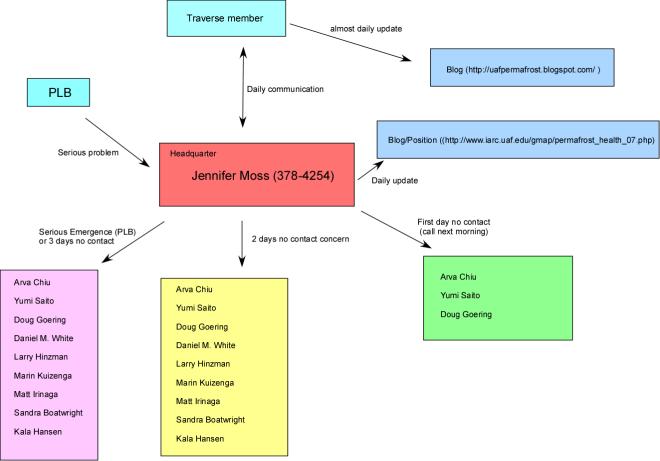
Daily
communication system
Tohru Saito call to headquarter
every night (between 6-9pm) for their position and condition remarks using
village phone system or satellite phone.
Jennifer Moss update web based
location map everyday (http://www.iarc.uaf.edu/gmap/permafrost_health_07.php)
Also snow machine members up
date their blog using village’s internet connection (as well as satellite
connection) (http://uafpermafrost.blogspot.com/ ).
Emergency action/flow chart
School list/information
Gladys Dart School (Manley Hot
Springs),
Maudry J Sommer School (Tanana),
Merreline A. Kangas School
(Ruby),
Galena high School
Koyukuk School,
Andrew K Demoski School (Nulato),
Innoko River School (Shageluk)
Holy Cross School,
Russian Mission School,
Marshall School,
St. Mary's School,
Support
teachers and principals:
We had an exciting snow machine trip along the
Yukon River during March 4 thru 17. First
6-7 days were unusually cold and severe conditions for snow machine and
drilling. However, it was getting
warmer the last 5 days. We stopped at 13 villages and talked to 11 classrooms
at 10 schools, including drilling 7 boreholes and installing 12 data loggers.
Local principals and teachers were very supportive of this project and
it was simply great spending time with everyone.
I believe the great success of this project is attributed to their
enormous aid. During the expedition, nine countries, more than 360 web access
was recorded on
our web site. 94% of the access was from United State.
We will post more detail active report sometimes soon on our web (www.uaf.edu/permafrost).
Again, thank you for your support!


